Standards
Canonical definitions and reference diagrams. Designed to be cited and reused.
UFDCM

UFDCM, GIP, and the Governance Intelligence Ontology
This page summarizes our core standards and reference frameworks. Each artifact is designed to be vendor-neutral, globally applicable, and measurable in practice.
UFDCM Standard
Core idea
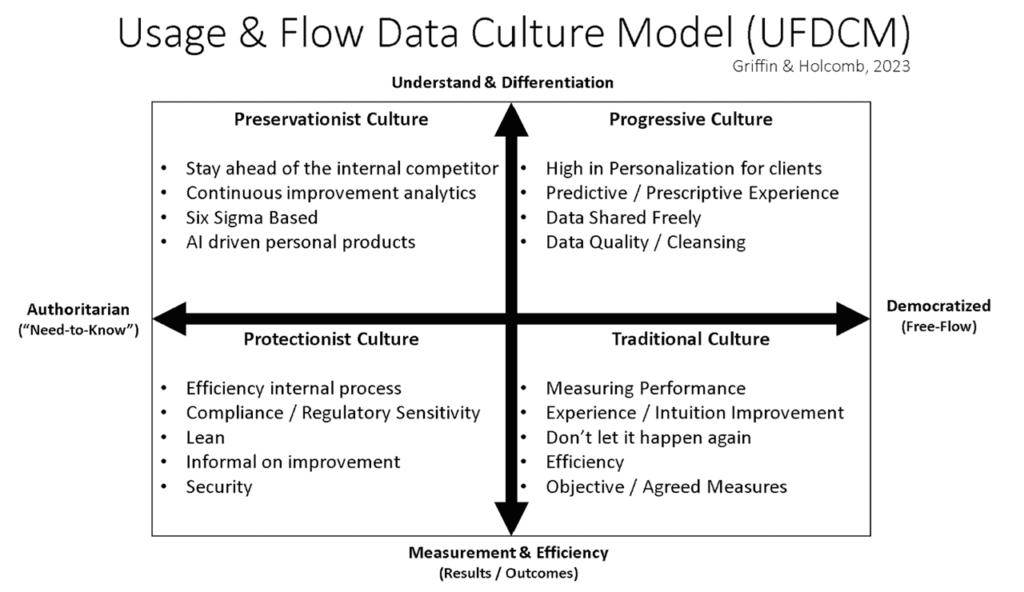
UFDCM uses two axes to characterize data culture:
- Usage: the extent to which governed data is used in decisions, operations, and accountability.
- Flow: the extent to which data moves across boundaries—teams, domains, programs—without friction.
These dimensions yield four archetypes that help practitioners diagnose cultural constraints and prioritize interventions.
- Progressive (high usage, high flow)
- Traditional (low usage, high flow)
- Preservationist (high usage, low flow)
- Protectionist (low usage, low flow)
 Figure: Figure: Quadrant representation.
Governance Intelligence Platform (GIP) Framework
A Governance Intelligence Platform is not “another catalog.” It is an intelligence layer that translates governance activity into maturity and trust insight. A practical GIP implementation typically includes:
Telemetry ingestion
Usage logs, workflow signals, policy enforcement events, lineage updates, stewardship actions, and adoption signals.
Normalized feature store
Standardized metrics enabling cross-domain comparison (maturity, drift, domain health, and trust).
Scoring engines
UFDCM maturity placement, trust scoring, drift detection, and readiness indicators for AI and data products.
Governance Intelligence Ontology (GIO)
GIO provides a shared vocabulary to align telemetry, governance concepts, and cultural indicators across tools and organizations. It supports consistent definitions for entities such as: data asset, domain, policy, stewardship action, usage event, and maturity score.
 Figure: Governance Intelligence Ontology